Comparing a 2D Keyboard and Mouse Interface to Virtual Reality for Human-in-the-Loop Robot Planning for Mobile Manipulation
Abstract
Human-in-the-loop robot teleoperation interfaces enable operators to control robots to complete complex tasks, as seen by the success of teams in the DARPA Robotics Challenge (DRC). In this work, we compare two human-in-the-loop planning interfaces, a 2D keyboard and mouse (KBM) interface modeled after those used in the DRC and a 3D virtual reality (VR) interface, for teleoperating a robot to perform navigation and manipulation tasks. In our study, we investigated operator performance, and cognitive workload while using the interface, as well as the perceived usability of each. We found that participants had better performance in both task types when using the KBM interface, however they experienced fewer collisions between the robot and the world in the VR interface. Given these findings, we recommend utilizing a KBM interface in low-risk situations where task performance is the primary factor. In high-risk scenarios, where collisions can be detrimental, we recommend using VR. With this work we aim to contribute to building effective and intuitive interfaces for human-in-the-loop planning to allow robots to complete complex tasks in challenging environments.
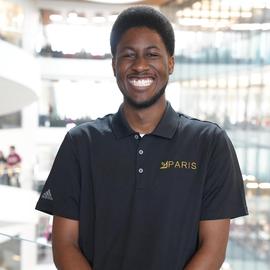
James Tukpah
PhD Candidate
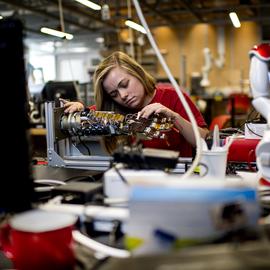
Murphy Wonsick
Ph.D. Alumna & Postdoc, Boston Dynamics AI Institute